


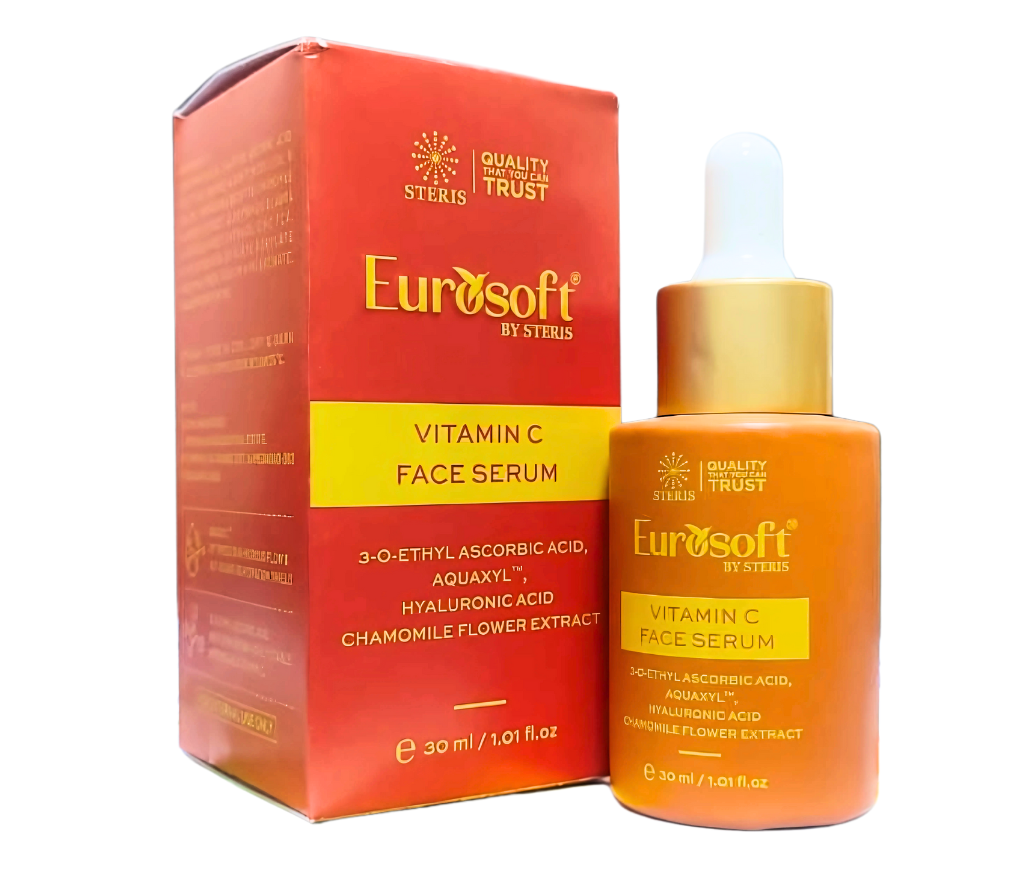
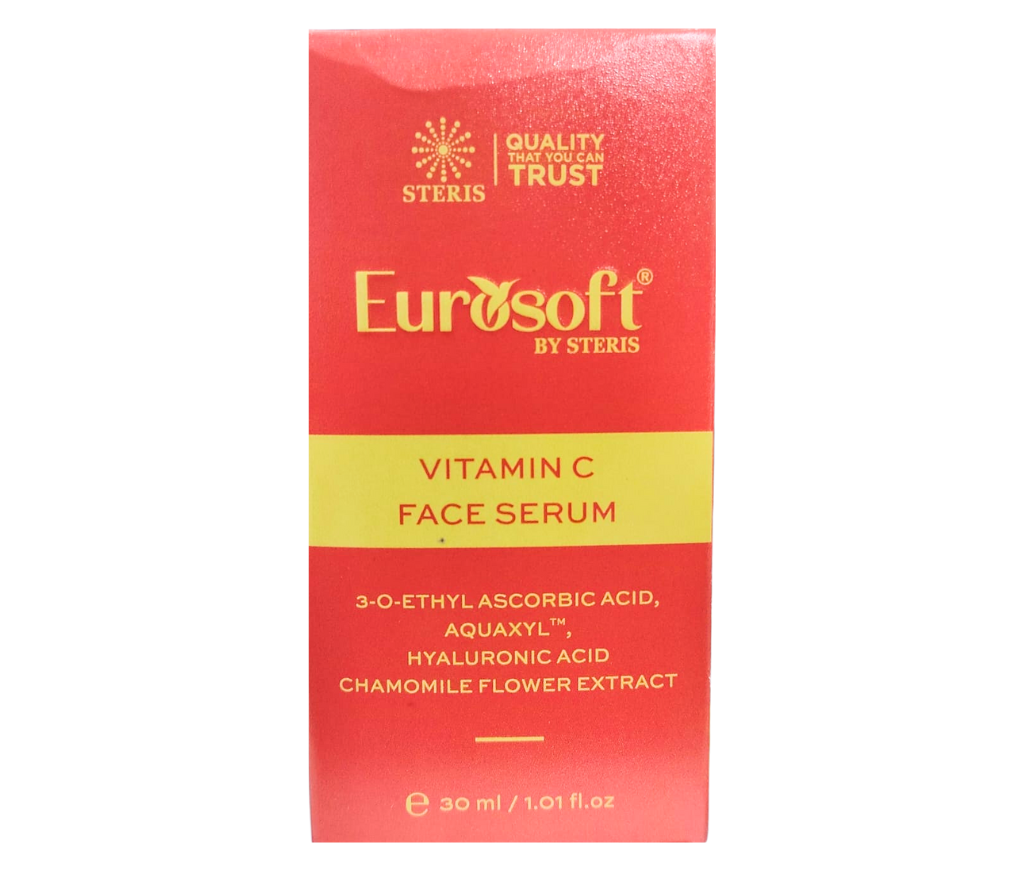
EUROSOFT VITAMIN C FACE SERUM
 Item requires a valid prescription
Manufactured By Steris Healthcare Pvt Ltd
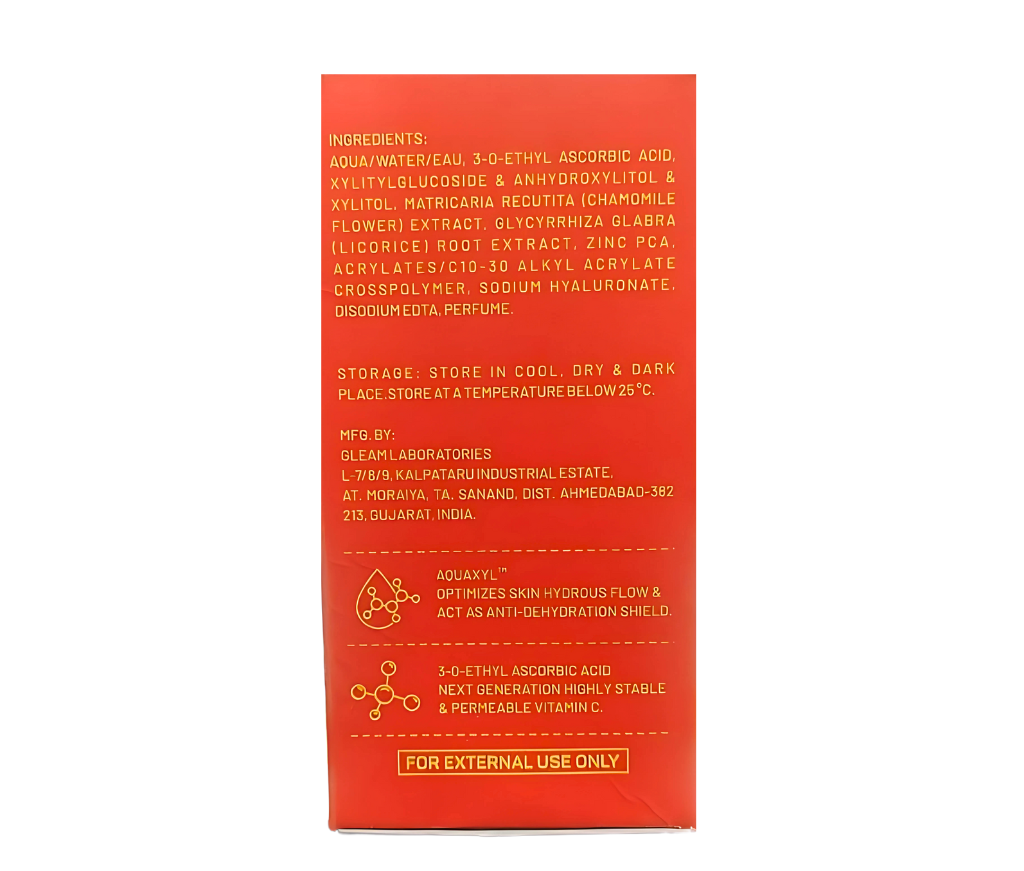
Composition AQUA/WATER/EAU, 3-O-ETHYL ASCORBIC ACID, XYLITYLGLUCOSIDE & ANHYDROXYLITOL & XYLITOL, MATRICARIA RECUTITA (CHAMOMILE FLOWER) EXTRACT, GLYCYRRHIZA GLABRA (LICORICE) ROOT EXTRACT, ZINC PCA. ACRYLATES/C10-30 ALKYL ACRYLATE CROSSPOLYMER, SODIUM HYALURONATE. DISODIUM EDTA, PERFUME
Rs 432.98
MRP Rs 618.55
(30% OFF)
Includes all taxes
Package SIZE
( FOR 30 ML )

100% Authentic
Products

Free
Shipping*

Products
Return Policy
Description:
The ingredient list beginning with AQUA/WATER/EAU and 3-O-ETHYL ASCORBIC ACID describes a water-based cosmetic formulation featuring a vitamin C derivative alongside hydrating, soothing, brightening, and skin-conditioning ingredients.
The standout ingredient is 3-O-Ethyl Ascorbic Acid, a relatively stable vitamin C derivative used in topical skincare. Research on vitamin C derivatives indicates that modified forms have been developed partly to address the instability and delivery challenges associated with pure L-ascorbic acid.
The formula also contains:
-
Xylitylglucoside
-
Anhydroxylitol
-
Xylitol
-
Matricaria Recutita (Chamomile) Flower Extract
-
Glycyrrhiza Glabra (Licorice) Root Extract
-
Zinc PCA
-
Acrylates/C10-30 Alkyl Acrylate Crosspolymer
-
Sodium Hyaluronate
-
Disodium EDTA
-
Perfume
Taken together, this ingredient profile suggests a product designed around antioxidant skincare, hydration, skin conditioning, and the appearance of uneven skin tone, although the actual cosmetic claims should be verified against the manufacturer's finished-product testing and label.
3-O-Ethyl Ascorbic Acid: The Key Ingredient
What is 3-O-Ethyl Ascorbic Acid?
3-O-Ethyl Ascorbic Acid is a derivative of vitamin C used in topical cosmetic formulations.
Pure vitamin C, or L-ascorbic acid, has substantial dermatological research behind its antioxidant, pigmentation-related, and photoaging applications. However, L-ascorbic acid is chemically unstable and can oxidize relatively easily. Researchers have therefore investigated vitamin C derivatives designed to improve stability and formulation characteristics.
Research specifically examining 3-O-ethyl-L-ascorbic acid has investigated its stability, physicochemical properties, antioxidant activity, and ability to enter skin tissue in experimental models.
This distinction matters for buyers: 3-O-ethyl ascorbic acid should not automatically be treated as identical to pure L-ascorbic acid. Evidence for topical vitamin C does not mean every vitamin C derivative or every finished cosmetic product produces the same clinical result.
Potential Benefits of 3-O-Ethyl Ascorbic Acid
1. Antioxidant support
Vitamin C derivatives are used in skincare partly because of their antioxidant properties. Antioxidants can help address oxidative stress associated with environmental exposure.
Research specifically investigating 3-O-ethyl ascorbic acid has demonstrated antioxidant activity in laboratory testing.
2. Helps improve the appearance of uneven skin tone
Vitamin C has been investigated for its effect on pigmentation and melanin production. Reviews of topical vitamin C describe antipigmentary applications, although the strength of evidence varies according to the exact formulation and derivative.
Therefore, a product containing 3-O-ethyl ascorbic acid may appeal to consumers looking for skincare targeting the appearance of dullness, uneven tone, or visible discoloration.
3. Supports an anti-aging skincare routine
Topical vitamin C has been studied in connection with collagen synthesis, photoaging, oxidative stress, and fine lines. However, results depend heavily on formulation quality, concentration, stability, and skin delivery.
For this reason, it is more accurate to describe 3-O-Ethyl Ascorbic Acid as an antioxidant and cosmetic brightening/skin-conditioning ingredient than to promise wrinkle removal.
Xylitylglucoside, Anhydroxylitol & Xylitol: The Hydration Complex
The combination of xylitylglucoside, anhydroxylitol, and xylitol is commonly used in cosmetic formulations aimed at supporting skin hydration.
These ingredients belong to a group of sugar-derived compounds used in cosmetic moisturizing systems. In a finished formulation, they can complement other humectant ingredients and help provide a more comfortable, hydrated skin feel.
This is particularly relevant when a vitamin C-focused product is being positioned as an everyday serum or treatment product. A formulation that combines an antioxidant ingredient with moisturizing components may be more appealing to people who want brightening plus hydration rather than a single-purpose treatment.
However, the presence of these ingredients does not establish a specific percentage of hydration improvement for the product unless the manufacturer has conducted finished-product testing.
Sodium Hyaluronate for Hydration
Sodium hyaluronate is the sodium salt of hyaluronic acid and is widely used in skincare formulations as a moisturizing and skin-conditioning ingredient.
In practical skincare terms, it is included to support a hydrated, smoother-feeling skin surface.
Its presence is especially useful for consumers who are looking for a vitamin C serum or brightening product that does not focus exclusively on antioxidant ingredients.
A formula containing both a vitamin C derivative and sodium hyaluronate can therefore be positioned around the following:
-
Antioxidant skincare
-
Hydration
-
Smoother-feeling skin
-
A healthy-looking complexion
-
Support for a brighter-looking appearance
The exact performance still depends on the complete formula.
Chamomile Flower Extract: Why Is It Included?
Matricaria Recutita (Chamomile Flower) Extract, commonly called chamomile extract, is a botanical cosmetic ingredient used for skin-conditioning purposes.
Chamomile is particularly attractive in formulations intended to provide a comfortable skincare experience because botanical extracts can complement antioxidant, moisturizing, and skin-conditioning ingredients.
However, "natural" does not automatically mean "non-irritating. " Botanical ingredients can cause reactions in susceptible individuals.
If you have sensitive or reactive skin, testing a new cosmetic on a small area before applying it broadly is a sensible precaution. The American Academy of Dermatology recommends testing skincare products on small areas before incorporating them into a routine.
Licorice Root Extract for Uneven Skin Tone
Glycyrrhiza Glabra (Licorice) Root Extract is another botanical ingredient frequently associated with products targeting the appearance of uneven skin tone.
Licorice-derived compounds have been investigated for cosmetic applications involving pigmentation. In a formula that already contains a vitamin C derivative, licorice root extract can contribute to a broader brightening-focused ingredient profile.
Nevertheless, buyers should distinguish between the following:
Ingredient potential → what research suggests an ingredient may do.
Finished-product performance → what the specific product actually demonstrates at its formulated concentration.
A high-quality product description should never imply that simply seeing licorice extract on an ingredient label guarantees removal of dark spots.
Zinc PCA: What Does It Do?
Zinc PCA combines zinc with PCA (pyrrolidone carboxylic acid) and is used in cosmetic formulations for skin-conditioning purposes.
It is particularly interesting in products aimed at people concerned about an oily or blemish-prone appearance.
Zinc PCA can, therefore, make the formula attractive to consumers searching for skincare that combines the following:
-
Vitamin C derivative
-
Hydration
-
Skin conditioning
-
Oilier-skin support
-
Brighter-looking skin
Again, ingredient presence should not be interpreted as proof that a cosmetic product treats acne or a medical skin condition.
If you have persistent acne, inflammatory skin disease, or another diagnosed dermatological condition, a dermatologist can determine whether a cosmetic product is appropriate alongside medical treatment.
What Are Acrylates/C10-30 Alkyl Acrylate Crosspolymer and Disodium EDTA?
Not every ingredient in a cosmetic formula is there to provide a headline skincare benefit.
Acrylates/C10-30 Alkyl Acrylate Crosspolymer is a formulation ingredient used to modify texture and help create the desired consistency of a cosmetic product.
Disodium EDTA is a chelating agent used in cosmetic formulations to bind certain metal ions and support formula stability.
These ingredients are examples of why consumers should evaluate the entire formulation, rather than judging a product exclusively by its "hero" ingredient.
A well-formulated skincare product requires more than active ingredients. Texture, stability, preservation, compatibility, packaging, pH, and sensory properties all influence the final product.
What Does Perfume Mean in the Ingredient List?
"Perfume" indicates that the formulation contains fragrance.
This can be important for people with fragrance sensitivity or a history of contact dermatitis.
The American Academy of Dermatology notes that fragrance can cause contact dermatitis in susceptible people and recommends fragrance-free products for individuals who need to avoid fragrance triggers.
Therefore, if your skin is highly sensitive, do not assume that a vitamin C or botanical formula is automatically suitable simply because it contains familiar skincare ingredients.
Key Benefits of This Ingredient Combination
Based on the ingredient profile, the product may be most attractive to consumers seeking a multifunctional cosmetic formula.
Potential benefit 1: Brighter-looking skin
The combination of 3-O-Ethyl Ascorbic Acid and licorice root extract creates a strong brightening-oriented ingredient story.
Potential benefit 2: Antioxidant-focused skincare
3-O-Ethyl Ascorbic Acid provides the principal antioxidant-focused component.
Topical vitamin C has substantial scientific literature concerning antioxidant activity and photoaging-related skincare.
Potential benefit 3: Hydration
Sodium hyaluronate plus the xylitylglucoside/anhydroxylitol/xylitol combination supports the formula's moisturizing positioning.
Potential benefit 4: Skin conditioning
Chamomile extract and other formulation components may contribute to a comfortable skin feel and conditioning effect.
Potential benefit 5: Suitable for a simplified routine
Rather than purchasing separate antioxidant, hydration, and skin-conditioning products, consumers may prefer a formula containing several complementary ingredient categories.
Who May Want to Use This Type of Product?
This type of ingredient combination may be particularly appealing to adults looking for cosmetic skincare for the following:
-
Dull-looking skin
-
Uneven-looking complexion
-
Visible signs of environmental stress
-
Dehydrated or dry-feeling skin
-
General antioxidant skincare
-
A brighter-looking appearance
-
A multi-benefit daily serum or treatment
It may be less suitable for someone who specifically wants a fragrance-free product, because this ingredient list contains perfume.
People with known allergies, highly reactive skin, eczema, rosacea, or previous reactions to botanical or fragranced products should be more cautious.
How to Use a Product Containing 3-O-Ethyl Ascorbic Acid
The correct directions depend on the actual finished product, so the manufacturer's label should always take priority.
A typical cosmetic routine might look like this:
Morning
-
Cleanse gently.
-
Apply the vitamin C-containing product according to its label.
-
Apply moisturizer if needed.
-
Finish with broad-spectrum sunscreen.
Evening
-
Cleanse.
-
Apply the product if the manufacturer recommends evening use.
-
Follow with moisturizer.
Vitamin C skincare should not be treated as a replacement for sunscreen. Research supports topical vitamin C as a complementary antioxidant in photoprotection, but it does not replace UV protection.
Can You Use It Every Day?
Possibly, depending on the product's formulation and your skin's tolerance.
The ingredient list alone does not tell us the concentration of 3-O-ethyl ascorbic acid, the product's pH, or the manufacturer's recommended frequency.
For a new skincare product, start according to the label and pay attention to how your skin responds.
If irritation develops, reduce or stop use and seek professional advice when necessary.
Possible Side Effects and Skin Reactions
Cosmetic products can cause unwanted reactions even when their individual ingredients are commonly used.
Potential reactions may include:
-
Redness
-
Burning or stinging
-
Itching
-
Dryness
-
Irritation
-
Rash
-
Swelling
-
Contact dermatitis
Fragrance is particularly relevant because fragrance ingredients can trigger contact dermatitis in susceptible individuals.
A vitamin C derivative may also feel irritating to some users depending on the formulation and individual skin sensitivity.
What should you do if irritation occurs?
Stop using the product if you develop significant irritation.
The AAD recommends testing new skincare products on small areas before wider use; its guidance describes testing a product twice daily for seven to 10 days.
Seek medical advice for severe swelling, blistering, breathing difficulty, widespread rash, or persistent symptoms.
Is This Formula Suitable for Sensitive Skin?
Not necessarily.
Although the formula contains ingredients commonly associated with moisturizing and soothing skincare, it also contains perfume.
Sensitive skin is highly individual. A product can be well tolerated by one person and irritating to another.
If you have sensitive skin, look for:
-
Fragrance-free options
-
Minimal ingredient formulas when appropriate
-
Products tested for sensitive skin
-
Clear manufacturer instructions
-
Patch-testing guidance
Do not assume that a botanical extract makes a product safer for sensitive skin.
Can This Product Remove Dark Spots?
It is better to say that this type of formulation may help improve the appearance of uneven skin tone or discoloration over time rather than claiming it removes dark spots.
Vitamin C has been studied for pigmentation-related applications, while 3-O-ethyl ascorbic acid has demonstrated tyrosinase-inhibitory activity in laboratory research.
However, laboratory activity is not equivalent to clinical proof that every finished cosmetic product will remove pigmentation.
Persistent, changing, or concerning pigmentation should be evaluated by a dermatologist.
3-O-Ethyl Ascorbic Acid vs. Pure Vitamin C
Consumers often search for "vitamin C serum" without realizing that different forms of vitamin C behave differently.
L-ascorbic acid is the classic form of vitamin C used in dermatology research, but it has formulation and stability challenges.
3-O-Ethyl Ascorbic Acid is a modified derivative developed partly to improve stability and formulation characteristics. Research demonstrates skin uptake in experimental models, but the effectiveness of a finished product depends on its entire formulation.
Therefore, a buyer should not choose solely based on the words "vitamin C." Consider the specific derivative, concentration, formulation, packaging, manufacturer, and evidence.
Buyer Guide: What to Check Before Buying
If you are searching to buy a skincare product containing 3-O-Ethyl Ascorbic Acid, the ingredient list is only the first step.
1. Verify the exact product
The ingredient list supplied here does not identify a brand or product name. Before purchasing, confirm:
-
Product name
-
Manufacturer
-
Product category
-
Net quantity
-
Complete ingredient list
-
Batch number
-
Expiry or period-after-opening information
-
Directions for use
2. Check the seller
Buy cosmetics from an established retailer, authorized seller, pharmacy, or the manufacturer's legitimate sales channel, where available.
Be cautious about products sold with unusually large discounts, missing packaging information, unclear manufacturer details, or exaggerated claims.
3. Compare the full formula
Do not compare products only by "vitamin C percentage."
A formulation containing 3-O-ethyl ascorbic acid, sodium hyaluronate, licorice, chamomile, and zinc PCA has a different purpose and sensory profile from a simple L-ascorbic-acid serum.
4. Consider fragrance
This particular ingredient list contains perfume. If fragrance commonly irritates your skin, consider a fragrance-free alternative.
5. Don't buy based on unrealistic claims
Be skeptical of claims such as the following:
-
"Instantly removes pigmentation"
-
"Permanently removes wrinkles"
-
"Works for everyone"
-
"Guaranteed acne cure"
-
"No side effects"
Cosmetic performance varies between users, and ingredient research cannot automatically validate every marketing claim.
E-E-A-T: How to Evaluate Claims About This Skincare Formula
For trustworthy skincare content, experience, expertise, authoritativeness, and trustworthiness matter.
A reliable product page should clearly distinguish between the following:
What the ingredient is:
3-O-Ethyl Ascorbic Acid is a vitamin C derivative.
What research suggests:
Vitamin C and its derivatives have antioxidant and pigmentation-related research behind them.
What the finished product proves:
This requires product-specific testing, concentration information, stability data, and, ideally, appropriately designed clinical testing.
What cannot be guaranteed:
A particular serum cannot promise identical results for every skin type.
This approach is more useful to buyers than simply repeating marketing claims.
Frequently Asked Questions
1. What is 3-O-ethyl ascorbic acid used for in skincare?
3-O-Ethyl Ascorbic Acid is a vitamin C derivative used primarily for antioxidant and cosmetic brightening/skin-conditioning purposes. Research has investigated its stability, antioxidant activity, and skin delivery.
2. Does 3-O-ethyl ascorbic acid brighten skin?
It may help improve the appearance of uneven skin tone. Vitamin C has been studied for pigmentation, while laboratory research has found tyrosinase-inhibitory activity for 3-O-ethyl ascorbic acid.
3. Is 3-O-Ethyl Ascorbic Acid the same as vitamin C?
It is a derivative of vitamin C, but it is not chemically identical to pure L-ascorbic acid. Different vitamin C derivatives can have different stability, penetration, and evidence profiles.
4. What are the benefits of sodium hyaluronate?
Sodium hyaluronate is commonly used as a moisturizing and skin-conditioning ingredient and can support a hydrated, smoother-feeling skin surface.
5. What does licorice root extract do in skincare?
Licorice root extract is commonly used in skincare aimed at improving the appearance of uneven skin tone and providing skin-conditioning benefits.
6. What is Zinc PCA used for?
Zinc PCA is a cosmetic skin-conditioning ingredient often found in formulas designed for combination, oily, or blemish-prone-looking skin.
7. Is chamomile extract good for the skin?
Chamomile extract is used as a botanical skin-conditioning ingredient. However, botanical ingredients can still cause reactions in susceptible people.
8. Can this product help with dark spots?
It may support a brighter-looking and more even complexion, but the ingredient list alone cannot establish that the finished product will remove dark spots.
9. Can I use a 3-O-Ethyl Ascorbic Acid product every day?
Many cosmetic vitamin C products are designed for regular use, but the correct frequency depends on the specific formulation. Follow the manufacturer's directions and adjust if your skin becomes irritated.
10. Can sensitive skin use this product?
Possibly, but caution is appropriate because the formula contains perfume. People with fragrance sensitivity may prefer a fragrance-free product.
11. Does this ingredient combination hydrate the skin?
The presence of sodium hyaluronate and the xylitylglucoside/anhydroxylitol/xylitol combination supports a moisturizing-focused formulation.
12. Can I use this product in the morning?
If the product label permits morning use, it can generally be incorporated into a morning skincare routine. Sunscreen remains important during daytime use.
13. Does vitamin C replace sunscreen?
No. Topical vitamin C can complement photoprotection, but it should not replace broad-spectrum sunscreen or other sun-protective measures.
14. Can this product cause irritation?
Yes. Any cosmetic can cause irritation or allergic contact dermatitis in susceptible individuals. Fragrance is a particular consideration in this formula.
15. How should I patch-test this skincare product?
The American Academy of Dermatology recommends testing new skincare products on small areas before applying them more broadly; its guidance suggests twice-daily testing for seven to 10 days.
16. Is 3-O-ethyl ascorbic acid suitable for oily skin?
It can be used in products formulated for different skin types. The suitability of this particular formula depends on its complete composition and texture, including the user's individual tolerance.
17. Is this product suitable for dry skin?
The inclusion of sodium hyaluronate and multiple moisturizing ingredients may make the formula appealing to dry or dehydrated skin, but the finished product's texture and moisturizing performance should be considered.
18. Can I use this product with other skincare ingredients?
Compatibility depends on the complete routine. Introduce new active products gradually rather than adding several potentially irritating products simultaneously.
19. How long does a vitamin C skincare product take to work?
There is no single timeframe that applies to every vitamin C derivative or finished cosmetic. Results depend on concentration, formulation, consistency, skin type, and the concern being addressed.
20. Should I buy this product based only on its ingredient list?
No. Check the brand, manufacturer, concentration where disclosed, product testing, packaging, expiry information, seller authenticity, fragrance content, and return policy before purchasing.
21. Is this ingredient list safe?
The presence of commonly used cosmetic ingredients does not by itself establish that a particular finished product is safe for every person. Safety depends on formulation, concentrations, manufacturing quality, intended use, and individual sensitivity. European cosmetic safety assessment, for example, considers the safety of cosmetic ingredients and finished products within a regulatory framework.
22. Does more 3-O-ethyl ascorbic acid mean better results?
Not necessarily. Higher concentration does not automatically equal better performance. Formulation stability, skin delivery, compatibility, and tolerability are also important.
23. Can I use this product if I have a fragrance allergy?
Because the ingredient list contains perfume, you should exercise caution and consider asking a dermatologist or pharmacist about whether it is appropriate for you. Fragrance can trigger contact dermatitis in susceptible individuals.
24. What should I look for when buying this product online?
Look for an identifiable manufacturer, a complete ingredient list, intact packaging, batch information, appropriate expiry information, a reputable seller, clear usage instructions, and realistic product claims.
25. What is the main benefit of this ingredient combination?
The formula is best understood as a multifunctional skincare combination centered on 3-O-ethyl ascorbic acid, with hydration, skin-conditioning, botanical, and antioxidant-support ingredients.
Conclusion
This ingredient combination is designed around a compelling modern skincare concept: a vitamin C derivative combined with hydrating, botanical, skin-conditioning, and oil-balancing ingredients.
The principal ingredient, 3-O-ethyl ascorbic acid, is a vitamin C derivative investigated for antioxidant properties, stability, and skin delivery. Vitamin C as a broader ingredient category has research supporting antioxidant, photoaging, collagen-related, and pigmentation-related applications, although evidence varies considerably between formulations and derivatives.
The addition of sodium hyaluronate and the Xylitylglucoside/Anhydroxylitol/Xylitol combination gives the formula a strong hydration angle, while licorice root extract, chamomile flower extract, and zinc PCA broaden its skin-conditioning profile.
From a buyer-intent perspective, however, the ingredient list should not be the only reason to purchase. Because the supplied information does not identify a specific manufacturer, product name, concentration, or clinical testing data, consumers should verify those details before buying.

