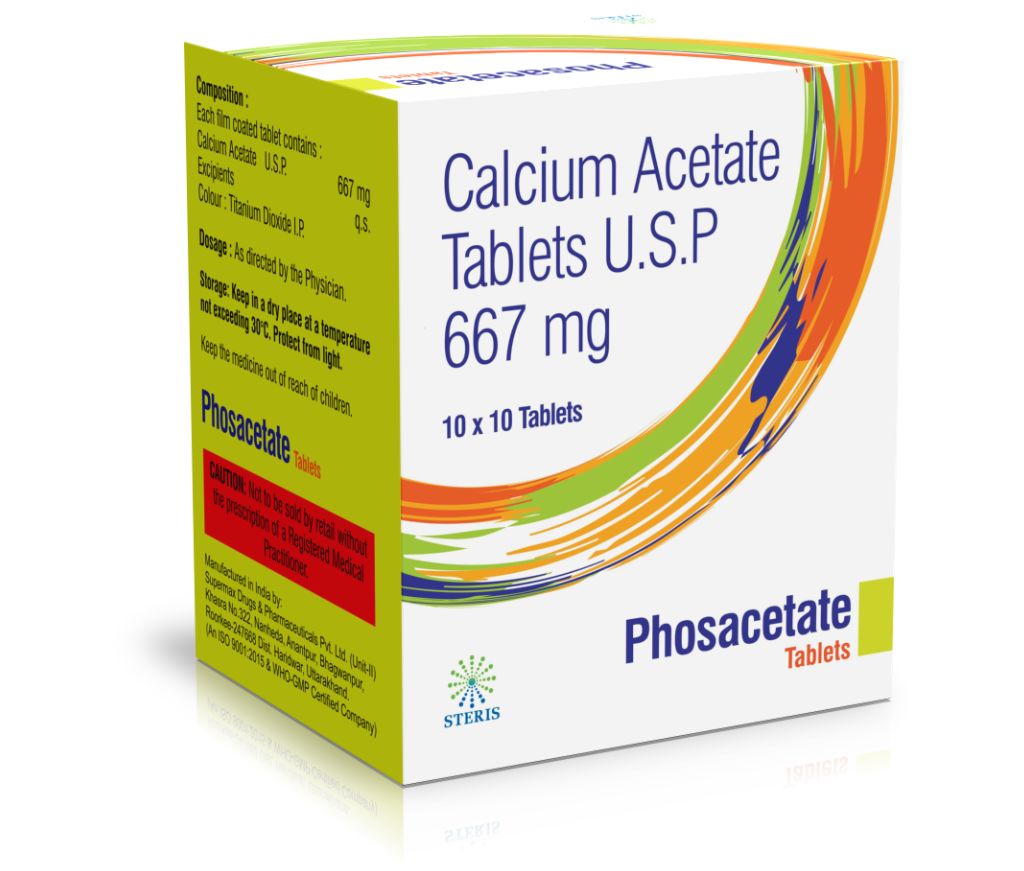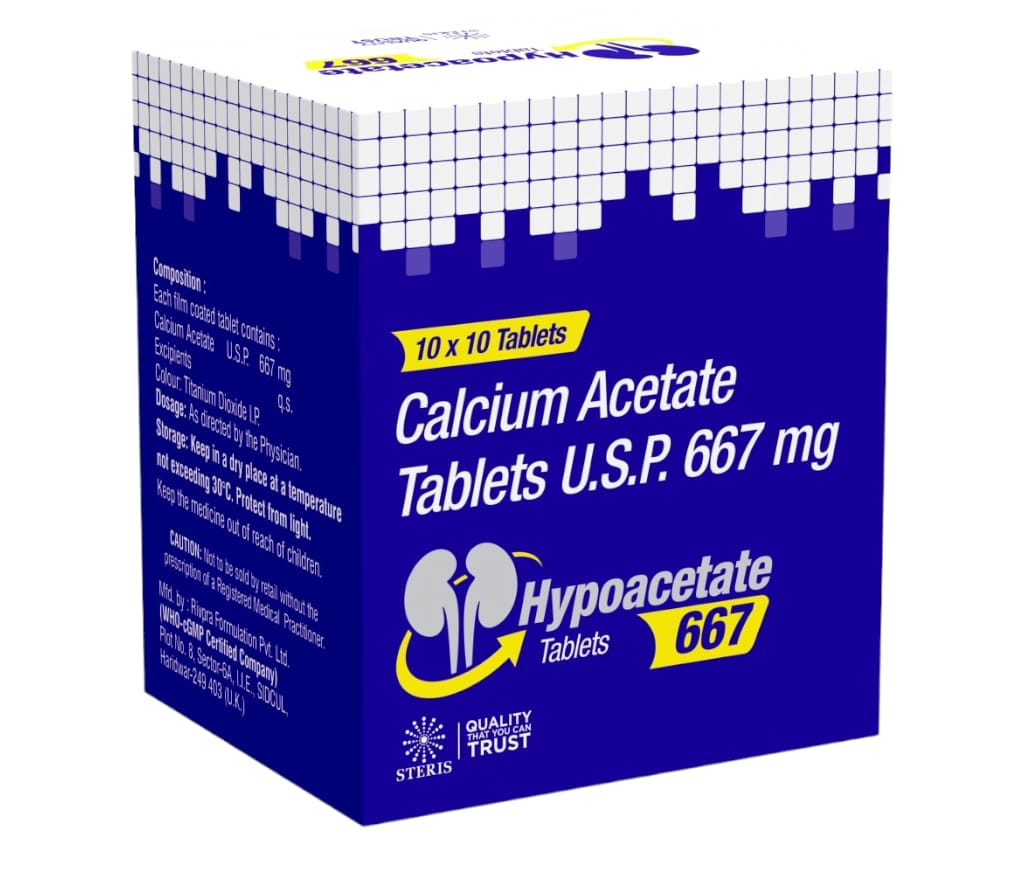
HYPOACETATE 667
 Item requires a valid prescription
Manufactured By STERIS HEALTHCARE PVT LTD
Composition Calcium Acetate (667mg)
Rs 81.90
MRP Rs 117.00
(30% OFF)
Includes all taxes
Package SIZE
( For 10 Tablets )

100% Authentic
Products

Free
Shipping*

Products
Return Policy
Description:
Calcium acetate 667 mg is a phosphate-binding medicine primarily used to help control high phosphate levels in the blood, particularly in people with advanced kidney disease and end-stage renal disease (ESRD). When kidney function becomes severely impaired, the kidneys may not remove enough phosphorus from the body. Calcium acetate works by binding dietary phosphate in the digestive tract, reducing its absorption into the bloodstream.
For patients searching for calcium acetate 667 mg uses, benefits, side effects, dosage, price, or how to buy calcium acetate 667 mg online, understanding how this medicine works and how it should be taken is important. Unlike ordinary calcium supplements, calcium acetate 667 mg is primarily used as a phosphate binder, not simply as a treatment for calcium deficiency.
The U.S. prescribing information identifies calcium acetate as a phosphate binder indicated to reduce serum phosphorus in patients with end-stage renal disease.
What Is Calcium Acetate 667 mg?
Calcium acetate 667 mg contains 667 mg of calcium acetate. It is available in tablet and capsule formulations, depending on the manufacturer and market.
A calcium acetate 667 mg tablet does not provide 667 mg of elemental calcium. One current U.S. product label specifies that a 667 mg calcium acetate tablet is equivalent to approximately 169 mg of elemental calcium.
Its principal therapeutic role is to bind phosphate from food in the gastrointestinal tract. The resulting calcium-phosphate compound is less readily absorbed, allowing more phosphate to leave the body through the stool. This helps reduce the amount of phosphorus entering the bloodstream.
Calcium Acetate 667 mg Uses
The primary use of 667 mg calcium acetate is controlling high blood phosphate levels, medically known as hyperphosphatemia.
It may be prescribed for people with advanced kidney disease, particularly patients receiving dialysis, because severely reduced kidney function limits the body's ability to eliminate phosphorus.
Calcium acetate 667 mg may therefore be used to:
- Help lower elevated blood phosphate levels.
- Bind dietary phosphate consumed with meals.
- Reduce phosphate absorption from the digestive tract.
- Support management of mineral and bone abnormalities associated with advanced kidney disease.
- Form part of a broader phosphate-control strategy involving diet, dialysis, and other medicines when required.
Current Indian medicine listings describe calcium acetate 667 mg products as being used to control high blood phosphate levels, particularly in people with kidney failure who are on dialysis.
How Does Calcium Acetate 667 mg Work?
Calcium acetate works inside the digestive tract rather than directly removing phosphate from the blood.
When you eat food containing phosphorus, calcium acetate can bind with phosphate in the gastrointestinal tract. This forms calcium phosphate, which is less readily absorbed. Consequently, less dietary phosphate enters the bloodstream.
This mechanism makes timing particularly important. Calcium acetate is generally taken with meals because its phosphate-binding action needs to occur when dietary phosphorus is present. Current Indian product information for calcium acetate 667 mg products recommends taking them with or after food.
Key Benefits of Calcium Acetate 667 mg
1. Helps control high phosphate levels
The primary benefit is lowering phosphate absorption from food, helping manage elevated serum phosphorus in appropriate kidney patients.
2. Works directly on dietary phosphate
Unlike medicines that act through the kidneys or hormones, calcium acetate binds phosphate in the digestive tract.
3. Useful in advanced kidney disease
People with severe kidney impairment may have difficulty eliminating phosphorus. Calcium acetate can be incorporated into their phosphate-management plan when prescribed.
4. Convenient 667 mg strength
The 667 mg strength is a commonly marketed formulation and gives clinicians flexibility when constructing an individualized phosphate-binder regimen.
5. Can form part of comprehensive CKD management
Phosphate control may involve a combination of dietary management, dialysis, and phosphate binders. Calcium acetate can be one component of this broader treatment approach.
Calcium Acetate 667 mg Dosage
There is no single calcium acetate 667 mg dosage that is appropriate for everyone.
The dose is individualized according to:
- Serum phosphorus level
- Serum calcium level
- Kidney function
- Dialysis status
- Dietary phosphorus intake
- Response to treatment
- Other medicines
- Risk of hypercalcemia
The U.S. prescribing information for calcium acetate capsules gives an initial adult dialysis dose of 2 capsules with each meal, followed by gradual adjustment according to serum phosphorus and calcium levels. However, this is product-label information and should not be used as a personal dosing instruction.
Your doctor may prescribe a different dose based on your laboratory results and the specific calcium acetate formulation.
Do not increase the number of tablets or capsules because your phosphate level remains high. Your healthcare professional may need to adjust your diet, dialysis treatment, or phosphate-binding therapy.
How to Take Calcium Acetate 667 mg
Calcium acetate is generally taken with meals or immediately after meals, according to the instructions for the particular product.
This timing helps the medicine bind phosphate present in food. Current Indian product information for several calcium acetate 667 mg products recommends taking the medicine with or after food.
Swallow the tablet or capsule according to the manufacturer's instructions. Do not change the prescribed schedule without consulting your doctor.
If you forget a dose, ask your healthcare professional what to do rather than taking extra medicine.
Calcium Acetate 667 mg Side Effects
Like all medicines, calcium acetate can cause side effects.
Potential side effects include:
- Increased calcium levels in the blood
- Nausea
- Vomiting
- Constipation
- Diarrhea
- Loss of appetite
- Abdominal discomfort
Current Indian product listings identify increased blood calcium, nausea, and diarrhea as potential side effects.
One of the most important safety concerns is hypercalcemia, or excessively high calcium in the blood.
Hypercalcemia: An Important Calcium Acetate Warning
Because calcium acetate contains calcium, excessive calcium absorption can lead to hypercalcemia.
Mild hypercalcemia may have few or no symptoms. More significant elevation can cause symptoms such as
- Constipation
- Nausea or vomiting
- Poor appetite
- Weakness
- Confusion
- Excessive tiredness
Severe hypercalcemia can become a medical emergency. The official PhosLo prescribing information specifically warns that hypercalcemia may occur during treatment and describes gastrointestinal and neurological manifestations at higher calcium levels.
For this reason, patients taking calcium acetate may need periodic monitoring of serum calcium and phosphorus.
Calcium Acetate 667 mg Drug Interactions
Calcium acetate can affect the absorption of some medicines by binding them in the digestive tract.
This is especially important for people with chronic kidney disease because they may already be taking multiple medicines.
Tell your doctor or pharmacist if you use:
- Thyroid medicines
- Antibiotics
- Iron supplements
- Calcium supplements
- Vitamin D products
- Antacids
- Other phosphate binders
- Kidney medicines
- Prescription or OTC medicines
- Herbal or nutritional supplements
Current Indian product information advises separating calcium acetate from certain medicines, including thyroid medicines, and recommends discussing additional calcium-containing products with a healthcare professional.
Do not automatically take calcium acetate together with another calcium-containing product.
Calcium Acetate 667 mg and Kidney Disease
Calcium acetate is particularly relevant to patients with advanced kidney disease because phosphorus balance becomes difficult when kidney function is severely reduced.
However, calcium acetate does not restore damaged kidney function. Its role is to help control phosphate absorption.
Treatment of chronic kidney disease generally requires a broader strategy that may include dietary management, blood-pressure control, diabetes management, dialysis, and other medications depending on the individual's condition.
Who Should Use Calcium Acetate 667 mg?
Calcium acetate should be taken only when recommended by a qualified healthcare professional.
Tell your doctor if you have:
- High blood calcium
- A history of kidney stones
- Severe gastrointestinal problems
- Other mineral-balance disorders
- A condition requiring calcium restriction
- Multiple calcium-containing medicines or supplements
Patients on dialysis should follow their nephrologist's instructions regarding phosphate intake, phosphate binders, and laboratory monitoring.
Buying Calcium Acetate 667 mg Online in India
If your doctor has prescribed calcium acetate 667 mg and you want to buy it online, verify the product carefully before purchasing.
Buyer checklist
- Confirm the active ingredient: Calcium acetate 667 mg.
- Check the formulation: Tablet and capsule products may differ.
- Verify the manufacturer: Check the manufacturer and marketer on the packaging.
- Check prescription requirements: Current Indian listings for several calcium acetate 667 mg products identify them as prescription medicines.
- Check batch and expiry date: Do not use expired or damaged products.
- Compare equivalent pack sizes: A 10-tablet pack and a 15-tablet pack should not be compared solely by total price.
- Use a reliable pharmacy: This helps ensure product authenticity and appropriate handling.
- Do not substitute calcium supplements: A calcium acetate phosphate binder is not interchangeable with an ordinary calcium supplement.
Calcium Acetate 667 mg Price in India
The calcium acetate 667 mg price varies depending on brand, manufacturer, pack size, pharmacy, location, and available discounts.
Recent Indian listings updated in September 2026 illustrate this variation. For example, Phosnier 667 is listed at ₹54.10 for 10 tablets against an MRP of ₹60, while Calostyle 667 is listed at ₹116 for 10 tablets against an MRP of ₹132. Hypoacetate 667 is listed at ₹103 for 10 tablets against an MRP of ₹117.19. These prices are snapshots and can change with availability, seller, and promotions.
Therefore, when searching for the best calcium acetate 667 mg price, compare the same composition, formulation, and pack quantity. The lowest displayed price is not necessarily the best purchasing choice.
Calcium Acetate 667 mg vs. Calcium Supplement
A common misconception is that calcium acetate 667 mg is simply a calcium supplement.
It is primarily a phosphate binder. Its therapeutic purpose in advanced kidney disease is to bind dietary phosphorus.
An ordinary calcium supplement is generally intended to provide calcium for nutritional or deficiency-related purposes. Calcium acetate used for hyperphosphatemia should therefore not be replaced with another calcium product without medical advice.
Frequently Asked Questions
1. What is calcium acetate 667 mg used for?
Calcium acetate 667 mg is primarily used to control high phosphate levels in the blood, particularly in patients with advanced kidney disease or end-stage renal disease. It binds dietary phosphate in the digestive tract and reduces its absorption.
2. How does calcium acetate 667 mg work?
Calcium acetate binds phosphate from food in the gastrointestinal tract, forming a compound that is less readily absorbed. This reduces the amount of dietary phosphate entering the bloodstream.
3. Should calcium acetate 667 mg be taken with food?
Yes, calcium acetate is generally taken with meals or after food so that it can bind phosphate present in the meal. Follow the specific instructions provided by your doctor and product label.
4. What are the side effects of calcium acetate 667 mg?
Potential side effects include high blood calcium, nausea, vomiting, constipation, diarrhea, and appetite changes. Hypercalcemia is an important adverse effect because calcium acetate contains calcium.
5. Can calcium acetate 667 mg lower phosphorus?
Yes. Calcium acetate is a phosphate binder specifically used to reduce dietary phosphate absorption and help lower elevated serum phosphorus in appropriate patients.
6. Is calcium acetate 667 mg a calcium supplement?
Not primarily. Although it contains calcium, calcium acetate 667 mg is primarily used as a phosphate binder in patients with kidney disease. It should not be substituted with an ordinary calcium supplement without medical advice.
7. Can calcium acetate 667 mg cause high calcium levels?
Yes. Hypercalcemia can occur during calcium acetate treatment. Patients may need periodic blood tests to monitor calcium and phosphorus levels, especially when doses are adjusted.
8. Can I take calcium acetate 667 mg with other medicines?
Some medicines can interact with calcium acetate or have their absorption affected. Thyroid medicines, antibiotics, iron, calcium, and vitamin-D products are particularly important to discuss with your healthcare professional.
9. Can I buy calcium acetate 667 mg online in India?
Yes, calcium acetate 667 mg products are currently listed by Indian online pharmacies. Several listings identify them as prescription medicines. Availability and prices vary between brands and pack sizes.
10. What happens if I take too much calcium acetate 667 mg?
Taking more than prescribed can increase the risk of hypercalcemia and other adverse effects. Do not increase your dose yourself. If you believe you have taken an excessive amount, contact a healthcare professional or emergency medical service promptly.
Conclusion
Calcium acetate 667 mg is an important phosphate-binding medicine used primarily to control elevated blood phosphorus in patients with advanced kidney disease, especially those with end-stage renal disease. Its main action occurs in the digestive tract, where it binds phosphate from food and reduces its absorption.
The key benefits of calcium acetate 667 mg include reducing dietary phosphate absorption, supporting phosphate management, and forming part of a comprehensive treatment strategy for patients with severe kidney impairment. It is not simply a calcium supplement and does not directly restore kidney function.
Available Substitutes